よむ、つかう、まなぶ。

資料3-6 コルヒチンの安全対策のための製造販売承認事項一部変更承認について[1.7MB] (12 ページ)
出典
| 公開元URL | https://www.mhlw.go.jp/stf/newpage_73884.html |
| 出典情報 | 薬事審議会 医薬品等安全対策部会(令和8年度第1回 6/18)《厚生労働省》 |
ページ画像
ダウンロードした画像を利用する際は「出典情報」を明記してください。
低解像度画像をダウンロード
プレーンテキスト
資料テキストはコンピュータによる自動処理で生成されており、完全に資料と一致しない場合があります。
テキストをコピーしてご利用いただく際は資料と付け合わせてご確認ください。
(参考4)
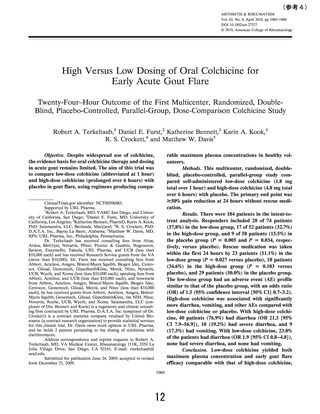
ARTHRITIS & RHEUMATISM
Vol. 62, No. 4, April 2010, pp 1060–1068
DOI 10.1002/art.27327
© 2010, American College of Rheumatology
High Versus Low Dosing of Oral Colchicine for
Early Acute Gout Flare
Twenty-Four–Hour Outcome of the First Multicenter, Randomized, DoubleBlind, Placebo-Controlled, Parallel-Group, Dose-Comparison Colchicine Study
Robert A. Terkeltaub,1 Daniel E. Furst,2 Katherine Bennett,3 Karin A. Kook,3
R. S. Crockett,4 and Matthew W. Davis5
Objective. Despite widespread use of colchicine,
the evidence basis for oral colchicine therapy and dosing
in acute gout remains limited. The aim of this trial was
to compare low-dose colchicine (abbreviated at 1 hour)
and high-dose colchicine (prolonged over 6 hours) with
placebo in gout flare, using regimens producing compa-
rable maximum plasma concentrations in healthy volunteers.
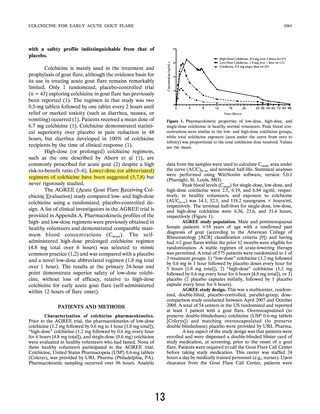
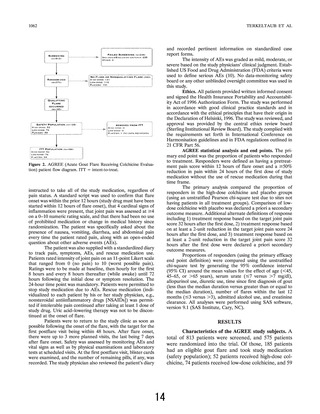
Methods. This multicenter, randomized, doubleblind, placebo-controlled, parallel-group study compared self-administered low-dose colchicine (1.8 mg
total over 1 hour) and high-dose colchicine (4.8 mg total
over 6 hours) with placebo. The primary end point was
>50% pain reduction at 24 hours without rescue medication.
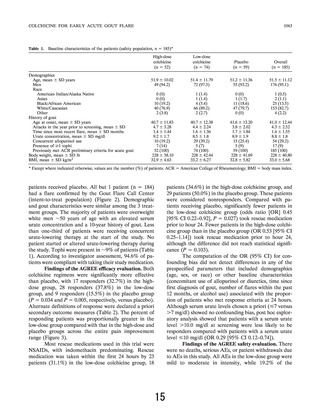
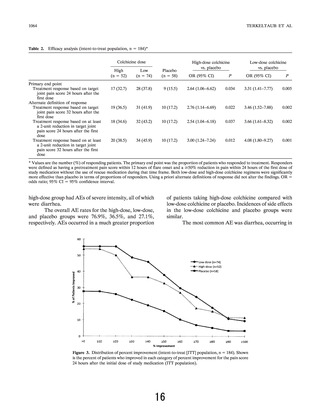
Results. There were 184 patients in the intent-totreat analysis. Responders included 28 of 74 patients
(37.8%) in the low-dose group, 17 of 52 patients (32.7%)
in the high-dose group, and 9 of 58 patients (15.5%) in
the placebo group (P ⴝ 0.005 and P ⴝ 0.034, respectively, versus placebo). Rescue medication was taken
within the first 24 hours by 23 patients (31.1%) in the
low-dose group (P ⴝ 0.027 versus placebo), 18 patients
(34.6%) in the high-dose group (P ⴝ 0.103 versus
placebo), and 29 patients (50.0%) in the placebo group.
The low-dose group had an adverse event (AE) profile
similar to that of the placebo group, with an odds ratio
(OR) of 1.5 (95% confidence interval [95% CI] 0.7–3.2).
High-dose colchicine was associated with significantly
more diarrhea, vomiting, and other AEs compared with
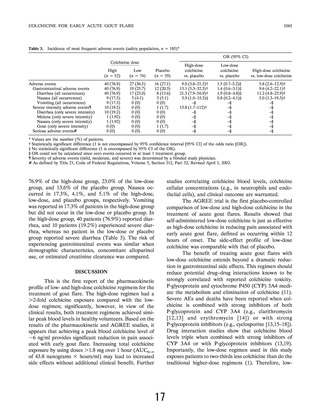
low-dose colchicine or placebo. With high-dose colchicine, 40 patients (76.9%) had diarrhea (OR 21.3 [95%
CI 7.9–56.9]), 10 (19.2%) had severe diarrhea, and 9
(17.3%) had vomiting. With low-dose colchicine, 23.0%
of the patients had diarrhea (OR 1.9 [95% CI 0.8–4.8]),
none had severe diarrhea, and none had vomiting.
Conclusion. Low-dose colchicine yielded both
maximum plasma concentration and early gout flare
efficacy comparable with that of high-dose colchicine,
ClinicalTrials.gov identifier: NCT00506883.
Supported by URL Pharma.
1
Robert A. Terkeltaub, MD: VAMC San Diego, and University of California, San Diego; 2Daniel E. Furst, MD: University of
California, Los Angeles; 3Katherine Bennett, PharmD, Karin A. Kook,
PhD: Salamandra, LLC, Bethesda, Maryland; 4R. S. Crockett, PhD:
D.A.T.A. Inc., Bayou La Batre, Alabama; 5Matthew W. Davis, MD,
RPh: URL Pharma, Inc., Philadelphia, Pennsylvania.
Dr. Terkeltaub has received consulting fees from Altus,
Ardea, BioCryst, Novartis, Pfizer, Procter & Gamble, Regeneron,
Savient, EnzymeRx, Takeda, URL Pharma, and UCB (less than
$10,000 each) and has received Research Service grants from the VA
(more than $10,000). Dr. Furst has received consulting fees from
Abbott, Actelion, Amgen, Bristol-Myers Squibb, Biogen Idec, Centocor, Gilead, Genentech, GlaxoSmithKline, Merck, Nitec, Novartis,
UCB, Wyeth, and Xoma (less than $10,000 each), speaking fees from
Abbott, Actelion, and UCB (less than $10,000 each), and honoraria
from Abbott, Actelion, Amgen, Bristol-Myers Squibb, Biogen Idec,
Centocor, Genentech, Gilead, Merck, and Nitec (less than $10,000
each); he has received grants from Abbott, Actelion, Amgen, BristolMyers Squibb, Genentech, Gilead, GlaxoSmithKline, the NIH, Nitec,
Novartis, Roche, UCB, Wyeth, and Xoma. Salamandra, LLC (employer of Drs. Bennett and Kook) is a regulatory and clinical consulting firm contracted by URL Pharma. D.A.T.A. Inc. (employer of Dr.
Crockett) is a contract statistics company retained by United Biosource (a contract research organization) to provide statistical services
for this clinical trial. Dr. Davis owns stock options in URL Pharma,
and he holds 2 patents pertaining to the dosing of colchicine with
clarithromycin.
Address correspondence and reprint requests to Robert A.
Terkeltaub, MD, VA Medical Center, Rheumatology 111K, 3350 La
Jolla Village Drive, San Diego, CA 92161. E-mail: rterkeltaub@
ucsd.edu.
Submitted for publication June 24, 2009; accepted in revised
form December 21, 2009.
1060
12
ARTHRITIS & RHEUMATISM
Vol. 62, No. 4, April 2010, pp 1060–1068
DOI 10.1002/art.27327
© 2010, American College of Rheumatology
High Versus Low Dosing of Oral Colchicine for
Early Acute Gout Flare
Twenty-Four–Hour Outcome of the First Multicenter, Randomized, DoubleBlind, Placebo-Controlled, Parallel-Group, Dose-Comparison Colchicine Study
Robert A. Terkeltaub,1 Daniel E. Furst,2 Katherine Bennett,3 Karin A. Kook,3
R. S. Crockett,4 and Matthew W. Davis5
Objective. Despite widespread use of colchicine,
the evidence basis for oral colchicine therapy and dosing
in acute gout remains limited. The aim of this trial was
to compare low-dose colchicine (abbreviated at 1 hour)
and high-dose colchicine (prolonged over 6 hours) with
placebo in gout flare, using regimens producing compa-
rable maximum plasma concentrations in healthy volunteers.
Methods. This multicenter, randomized, doubleblind, placebo-controlled, parallel-group study compared self-administered low-dose colchicine (1.8 mg
total over 1 hour) and high-dose colchicine (4.8 mg total
over 6 hours) with placebo. The primary end point was
>50% pain reduction at 24 hours without rescue medication.
Results. There were 184 patients in the intent-totreat analysis. Responders included 28 of 74 patients
(37.8%) in the low-dose group, 17 of 52 patients (32.7%)
in the high-dose group, and 9 of 58 patients (15.5%) in
the placebo group (P ⴝ 0.005 and P ⴝ 0.034, respectively, versus placebo). Rescue medication was taken
within the first 24 hours by 23 patients (31.1%) in the
low-dose group (P ⴝ 0.027 versus placebo), 18 patients
(34.6%) in the high-dose group (P ⴝ 0.103 versus
placebo), and 29 patients (50.0%) in the placebo group.
The low-dose group had an adverse event (AE) profile
similar to that of the placebo group, with an odds ratio
(OR) of 1.5 (95% confidence interval [95% CI] 0.7–3.2).
High-dose colchicine was associated with significantly
more diarrhea, vomiting, and other AEs compared with
low-dose colchicine or placebo. With high-dose colchicine, 40 patients (76.9%) had diarrhea (OR 21.3 [95%
CI 7.9–56.9]), 10 (19.2%) had severe diarrhea, and 9
(17.3%) had vomiting. With low-dose colchicine, 23.0%
of the patients had diarrhea (OR 1.9 [95% CI 0.8–4.8]),
none had severe diarrhea, and none had vomiting.
Conclusion. Low-dose colchicine yielded both
maximum plasma concentration and early gout flare
efficacy comparable with that of high-dose colchicine,
ClinicalTrials.gov identifier: NCT00506883.
Supported by URL Pharma.
1
Robert A. Terkeltaub, MD: VAMC San Diego, and University of California, San Diego; 2Daniel E. Furst, MD: University of
California, Los Angeles; 3Katherine Bennett, PharmD, Karin A. Kook,
PhD: Salamandra, LLC, Bethesda, Maryland; 4R. S. Crockett, PhD:
D.A.T.A. Inc., Bayou La Batre, Alabama; 5Matthew W. Davis, MD,
RPh: URL Pharma, Inc., Philadelphia, Pennsylvania.
Dr. Terkeltaub has received consulting fees from Altus,
Ardea, BioCryst, Novartis, Pfizer, Procter & Gamble, Regeneron,
Savient, EnzymeRx, Takeda, URL Pharma, and UCB (less than
$10,000 each) and has received Research Service grants from the VA
(more than $10,000). Dr. Furst has received consulting fees from
Abbott, Actelion, Amgen, Bristol-Myers Squibb, Biogen Idec, Centocor, Gilead, Genentech, GlaxoSmithKline, Merck, Nitec, Novartis,
UCB, Wyeth, and Xoma (less than $10,000 each), speaking fees from
Abbott, Actelion, and UCB (less than $10,000 each), and honoraria
from Abbott, Actelion, Amgen, Bristol-Myers Squibb, Biogen Idec,
Centocor, Genentech, Gilead, Merck, and Nitec (less than $10,000
each); he has received grants from Abbott, Actelion, Amgen, BristolMyers Squibb, Genentech, Gilead, GlaxoSmithKline, the NIH, Nitec,
Novartis, Roche, UCB, Wyeth, and Xoma. Salamandra, LLC (employer of Drs. Bennett and Kook) is a regulatory and clinical consulting firm contracted by URL Pharma. D.A.T.A. Inc. (employer of Dr.
Crockett) is a contract statistics company retained by United Biosource (a contract research organization) to provide statistical services
for this clinical trial. Dr. Davis owns stock options in URL Pharma,
and he holds 2 patents pertaining to the dosing of colchicine with
clarithromycin.
Address correspondence and reprint requests to Robert A.
Terkeltaub, MD, VA Medical Center, Rheumatology 111K, 3350 La
Jolla Village Drive, San Diego, CA 92161. E-mail: rterkeltaub@
ucsd.edu.
Submitted for publication June 24, 2009; accepted in revised
form December 21, 2009.
1060
12